

MatrixOne Intelligence 2026 Release Notes
September 4, 2026
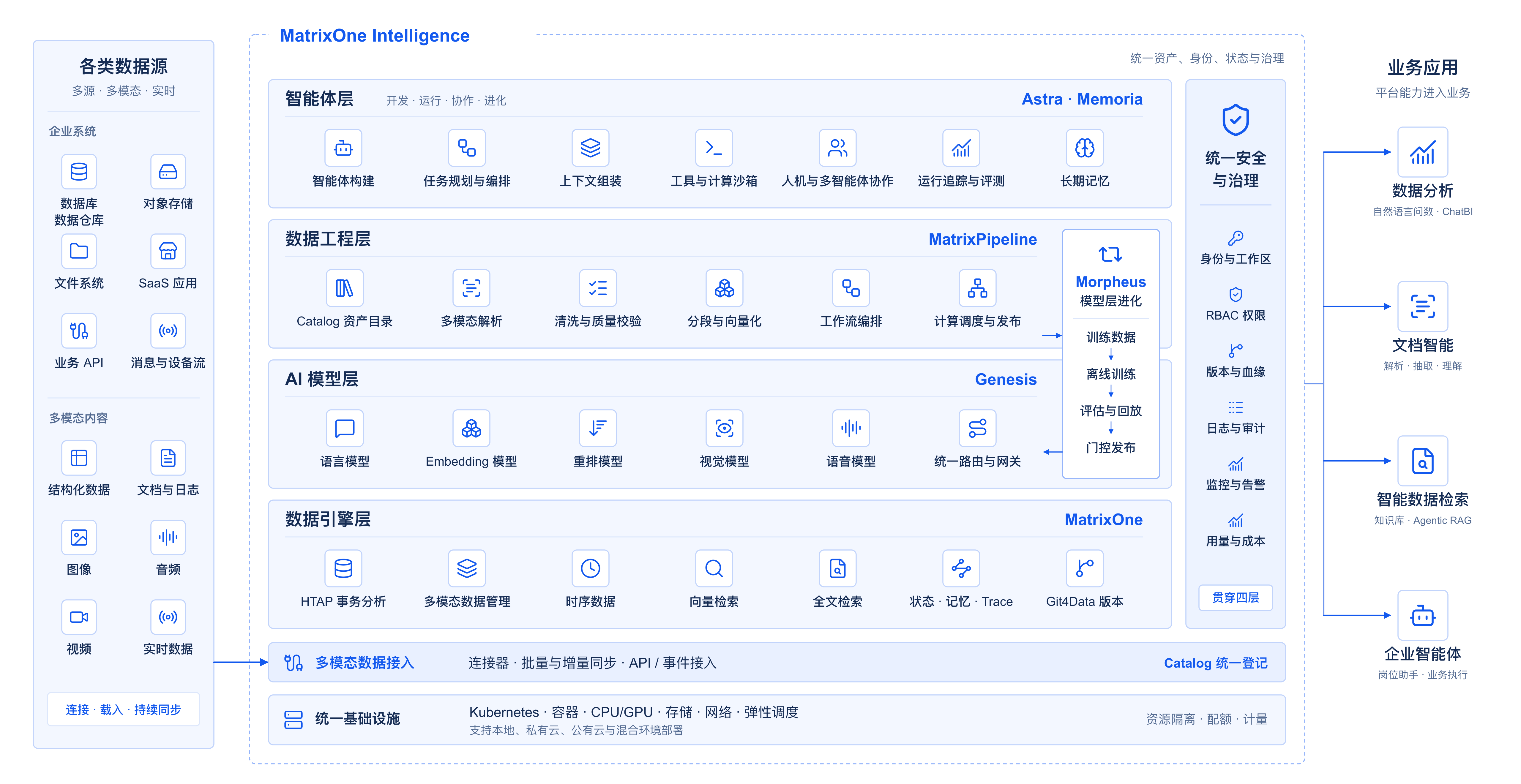
MatrixOne Intelligence brings data processing and agent building together in one platform, covering data ingestion, parsing, governance, retrieval, and agent building. Structured and unstructured data can be managed in a unified Catalog and reused by workflows, knowledge bases, and agents.
Features
Data ingestion and unified management
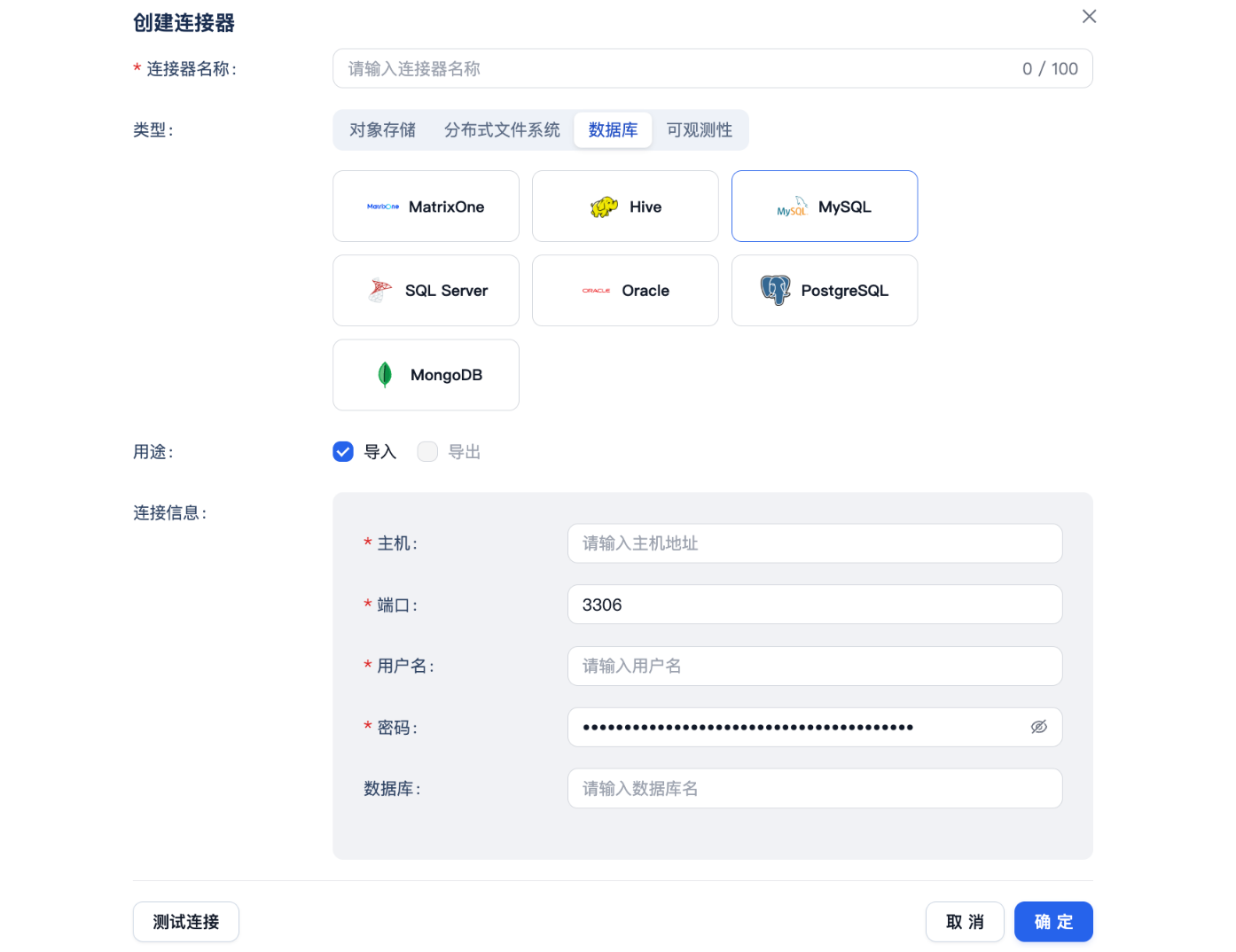
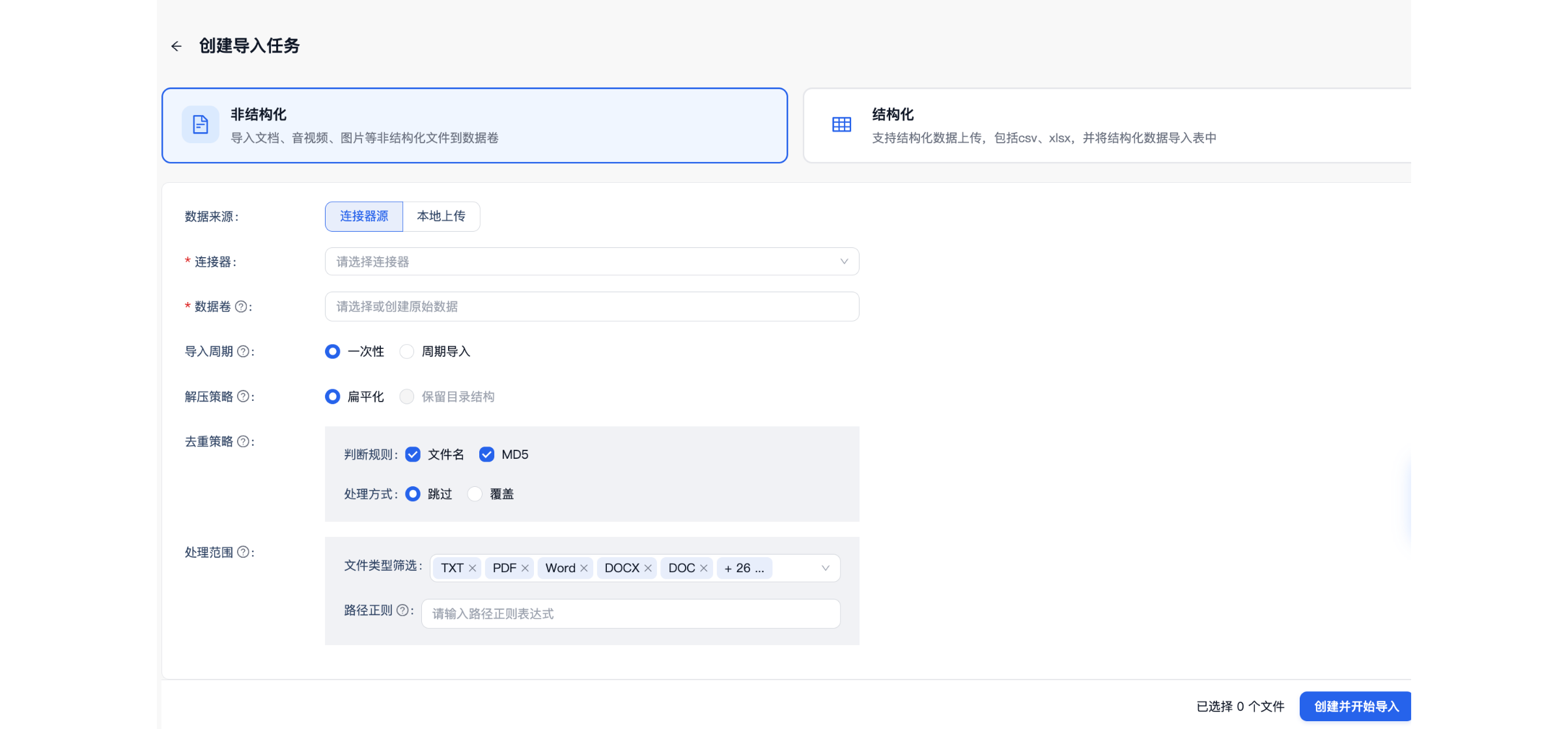
Object storage, distributed file systems, and mainstream databases can be connected through connectors. Structured and unstructured data are stored in the Catalog with unified permission management and lineage tracking, and can be processed together in the same workflow.
Workflows and data engineering
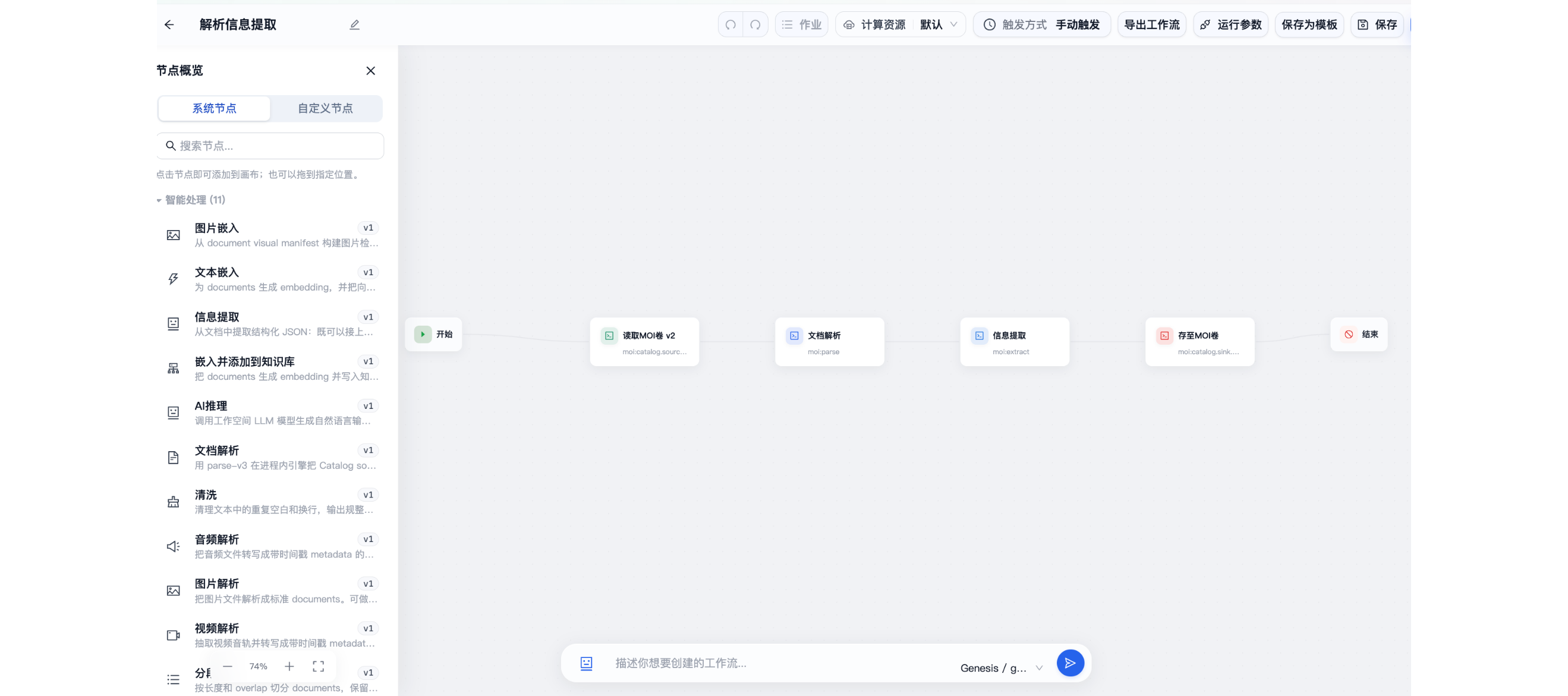
Workflows support information extraction, model inference, data cleansing, and flow-control nodes. Custom nodes can be written in SQL or Python, then managed and reused as versioned operators in the Catalog. Workflows support manual, scheduled, and data-triggered runs, and can be published as skills or tools that agents can call.
Knowledge bases and evidence-based retrieval
Knowledge bases support combined retrieval across tables and files, NL2SQL, and semantic configuration. Answers can show source citations; files and segments support updates, editing, enablement, expiry dates, and version management.
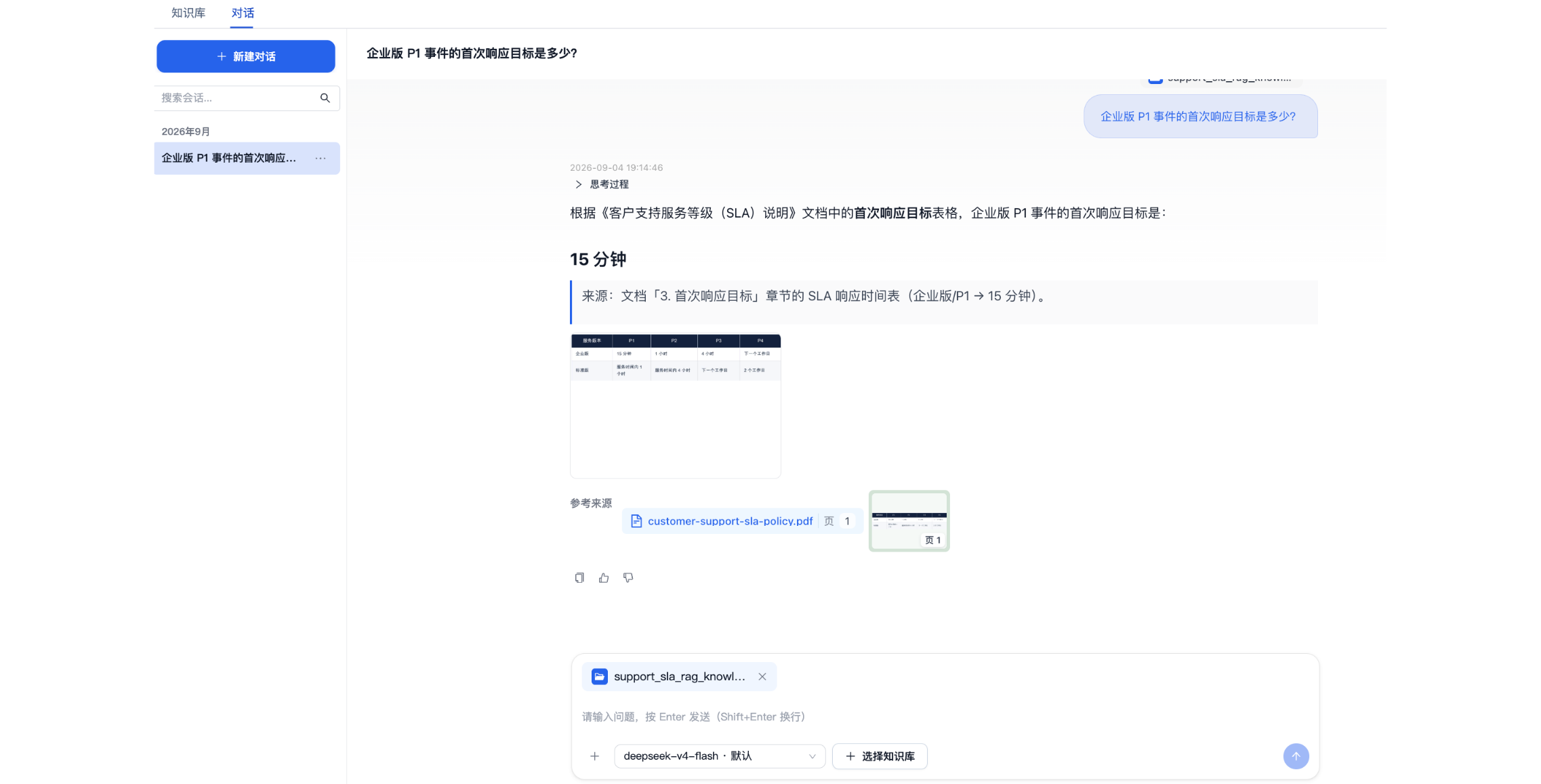
Data and system operations
SQL Editor and Workbooks, SQL History, job history, and operation logs help review query and processing records. Roles can be configured by object type, permission, and scope, including column- and row-level table access. Compute resources support shared and dedicated resources.
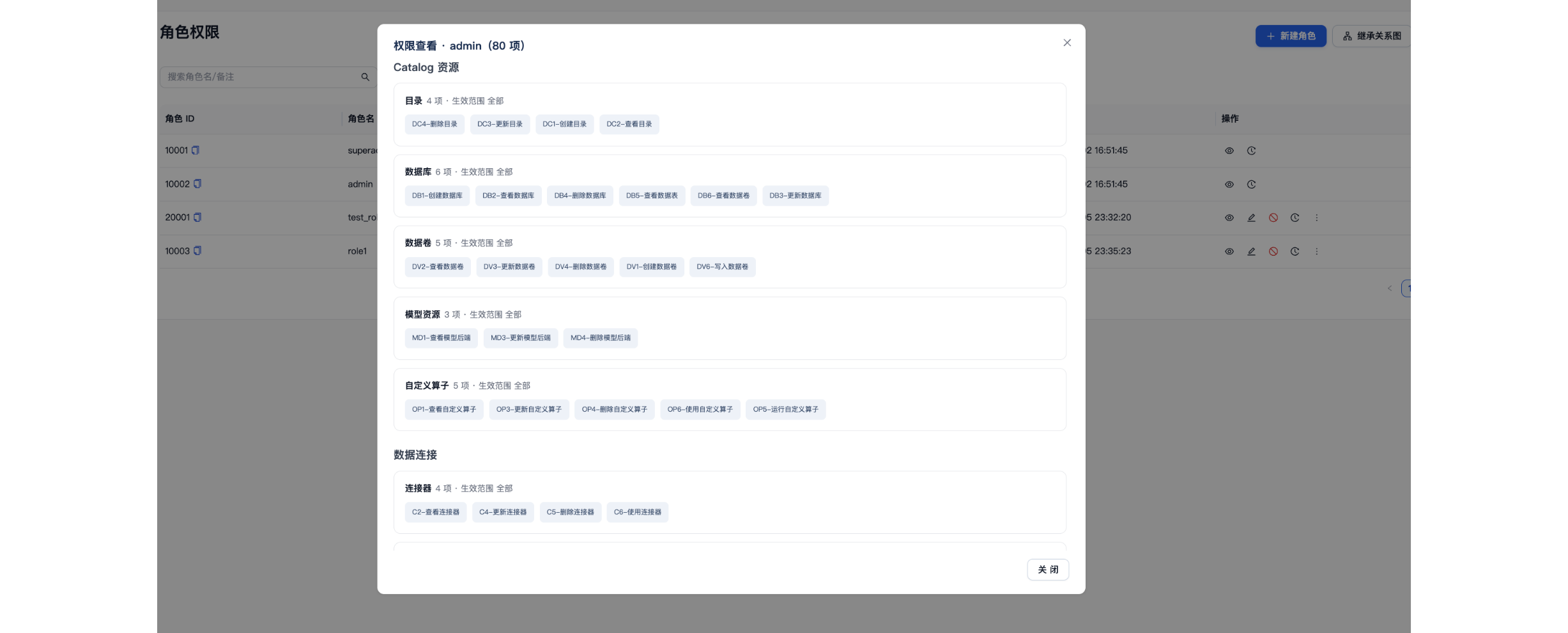
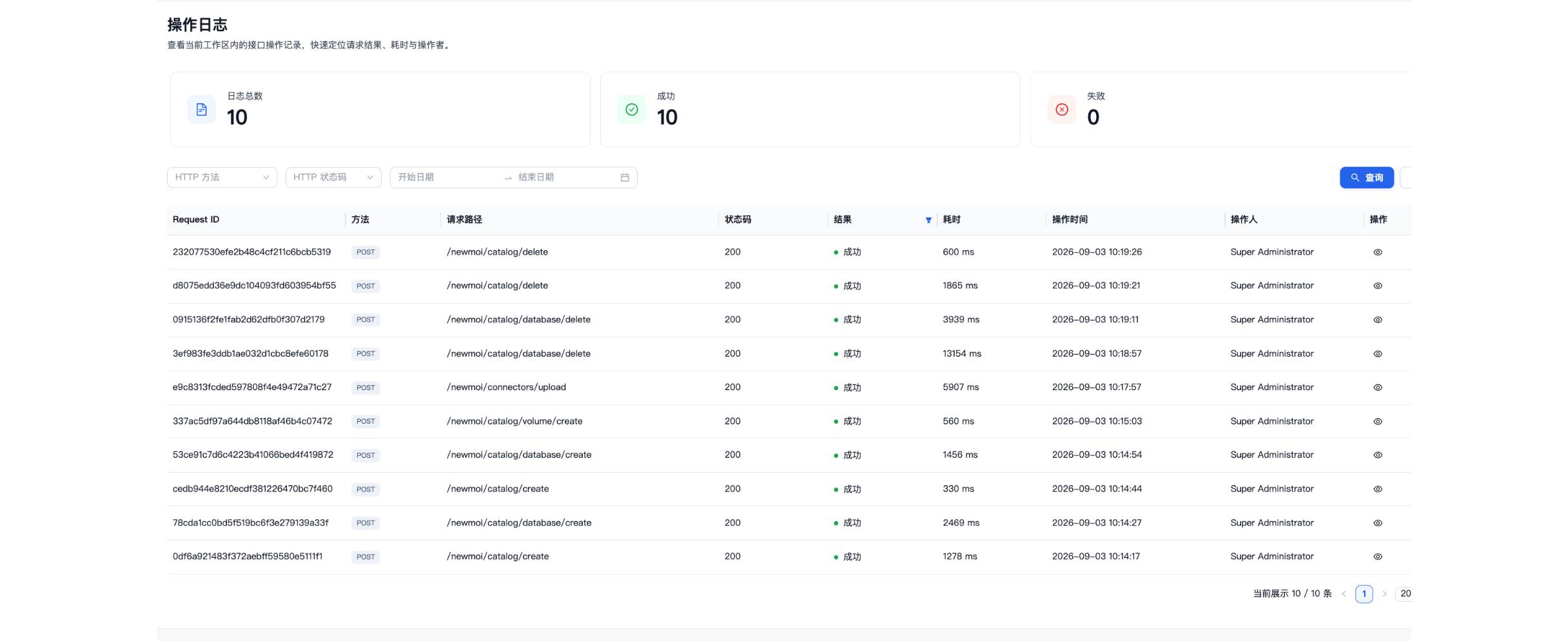
Agents, model services, and accounts
Agents can be configured with prompts, knowledge bases, skills, and tools, and can use workflows as callable capabilities. The platform supports scheduled tasks and messaging-channel integrations, and can connect to external systems such as GitHub, Grafana, and Kubernetes. Genesis provides model services, key management, call logs, and an OpenAI-compatible API. AI Studio, Genesis, and MatrixOne share one account system and support personal access tokens and service accounts.
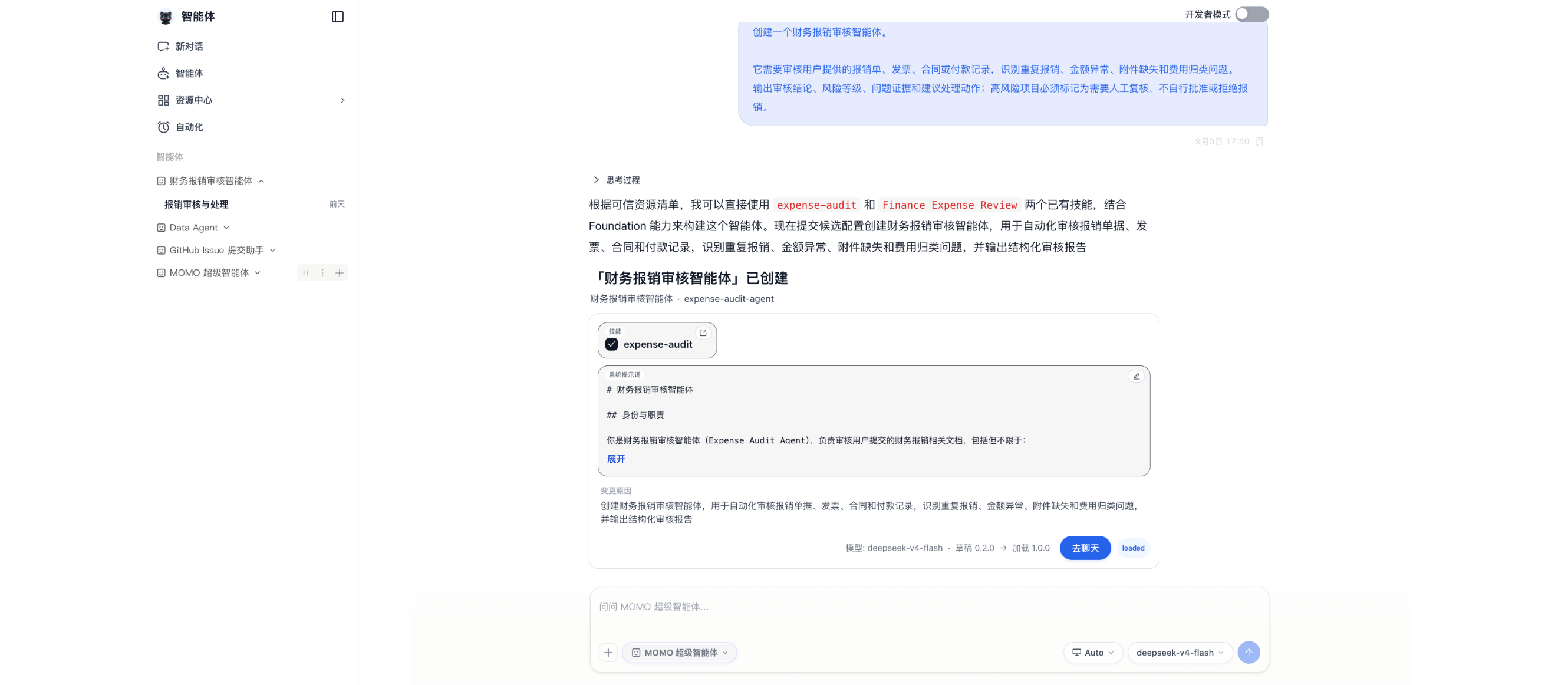
Agent platform experience and access control
The AI Studio root route now opens the agent platform by default, and connection management is integrated into the agent workspace. The new-conversation page offers guided tasks for organizing documents, analyzing data, and finding information. Knowledge bases support semantic configuration for business logic, table and column descriptions, SQL result sets, and optimization examples. The platform also supports site-level default_locale configuration and improves management of roles, service accounts, and customer identity providers.
Optimizations
Improved page layouts and Chinese-English consistency across Skills, Knowledge Bases, and Tools.
Improved navigation across the agent platform entry point, Resource Center, and connection configuration.
Bug Fixes
Fixed Skills content appearing in English in the Chinese interface.
Fixed quick-entry new conversations not responding after the first use.
Fixed language changes on the sign-in page not taking effect immediately.
Fixed authentication and access issues including workspace-list loading failures, sign-in callback errors, and invalid API keys.
Fixed bound structured-data tools being unavailable at agent runtime.
Fixed model selection, configuration, and execution issues in information extraction, knowledge base, and workflow scenarios.
August 28, 2026
Features
Agent Resource Center
Agent resources are consolidated in Resource Center, where system and user-created resources can be viewed and managed in Skills, Tools, and Knowledge Bases.
Message channel instances
Agents can configure and manage message channel instances, including connection testing and binding status.
Astra knowledge base binding
Astra agents can bind knowledge bases and use them for document retrieval, Q&A, and structured data queries in conversations.
Agent quick-start examples
Added agent quick-start examples for expense auditing, policy comparison, resume screening, and product documentation Q&A.
Optimizations
Embedded the parsing gateway in go-worker and added concurrency control, unified artifact processing, and runtime observability.
Improved the unified access entry point for private deployments, supporting HTTP, IP:port, and domain-based access.
Bug Fixes
Fixed completed MySQL imports remaining in the Pending state.
Fixed invited members with assigned roles being unable to view existing workspace connectors.
Fixed Workflow pages not switching after changing workspaces.
Fixed agent conversations being unable to use query tools after a Grafana channel was bound.
Fixed user-created agents being unable to use Web Search.
Fixed knowledge bases showing as ready but remaining unavailable to agents at runtime.
August 21, 2026
Features
Agents can now use
moi-cliin the new sandbox, with eph-sandbox replacing nsjail-sandbox capabilities.Workspace lists now support copying workspace IDs and display associated account information.
The SQL editor database tree now shows the mapping between display and physical names and follows Catalog ordering.
Added a customer feedback attribution assistant example for analyzing knowledge base content.
Optimizations
Added concurrency and memory admission controls to parse-gateway, along with Deployment templates, worker images, and ConfigMap rendering to reduce resource risks during high-concurrency parsing.
Aligned file parsing API contracts with MinerU 2.7.4 and improved Parse V3 image semantics and OCR fallback consistency across product surfaces.
Improved login failure and agent failure messages for easier troubleshooting.
Bug Fixes
Fixed slow responses for empty query history results.
Fixed repeated 500 errors in Catalog lists when Shared Catalog owner authorization failed.
Fixed errors that prevented MOC pages from switching languages.
Fixed repeated
compute_result_tablefailures in knowledge base conversations.Fixed conversations failing after Memoria MCP binding and incorrect tool state that prevented recovery by unbinding.
Fixed Catalog operators and models appearing only after filtering.
Fixed incorrect interpretation of “last year” in structured knowledge base Q&A.
Fixed a 500 error when deleting a Catalog Semantic Model after knowledge base cleanup.
Fixed personal access tokens not working with Product APIs and SDKs.
Fixed selecting one skill sometimes selecting multiple skills.
Fixed missing display names for phone-registered accounts and inconsistent workspace and avatar menu labels.
Fixed publishers being unable to delete a publication after a subscriber unsubscribed.
Fixed the account email-binding flow not reflecting password and email verification states.
Fixed personal API key self-service endpoints returning
200despite a business failure.Fixed missing frontend guidance when deleting a compute resource bound to a workflow.
August 14, 2026
Features
Workflow processing results in Catalog now support data lineage inspection.
Personal access tokens now support creating up to 20 API keys.
Compute resources now support multi-worker deployment templates and lifecycle management.
Added MatrixOne-compatible naming validation to the Catalog API and unified Catalog resource naming rules.
Optimizations
Standardized list action icons and hover hints for more consistent interactions.
Improved the knowledge base creation flow, fixed index configuration, and data source interactions.
Added Parser V3 quality baselines, end-to-end coverage, and support for complex cells and cross-page tables.
Improved cleanup of invalid state and login recovery after session protocol migration.
Bug Fixes
Fixed periodic structured loads repeatedly invoking callbacks after a 409 gate response was parsed incorrectly.
Fixed runtime PATs and API keys being written to response logs.
Fixed Parser V3 missing some PPTX page titles.
Fixed agent conversations failing persistently after an Astra provider session was missing.
Fixed the lack of a discoverable product administrator account or onboarding path in QA.
Fixed load task lists failing when historical tasks referenced deleted databases.
Fixed Catalog databases not showing creation and update times.
Fixed missing lineage tracing in workflow artifact previews.
Fixed feedback hover text and error messages appearing in English in the Chinese interface.
Fixed Web Search/Open bindings failing at runtime when WebBackend was not enabled in deployment.
Fixed agent-uploaded images that could not be previewed, downloaded, or parsed.
Fixed startup failure during upgrade to 5.0.5 caused by premature Catalog Agent resource initialization.
Fixed workload column loading failures for read-only compute resource users.
Fixed backend rescheduling interrupting structured loads with
stream closed.Fixed compute resource restarts remaining unhealthy when historical worker image tags could not be resolved.
August 7, 2026
Features
Knowledge base conversations now support dedicated Query Visual previews and distinguish visual processing failure types.
Reviewed end-to-end timeout control after MOI 5.x Workflow services migrated to atomic API services.
Optimizations
Adjusted structured-load maximum row configuration by source table primary key and added clear guidance for no-primary-key limits.
Removed hard-coded English user-facing error text from backend handlers.
Improved entry points and error messages for deleting non-empty directories and added high-priority table permission controls.
Bug Fixes
Fixed new conversations selecting a deleted agent after an agent conversation was deleted.
Fixed first login failures after signing out of an old account and registering a new account.
Fixed Keycloak logout failures caused by incorrectly adding
return_totopost_logout_redirect_uri.Fixed subsequent requests failing after a single-turn conversation failed once.
Fixed SQL History queries failing when the Other type was selected.
Fixed table creation permission failures when writing vector indexes to Catalog Volume databases.
Fixed knowledge base Q&A searching the
moidatabase when the index database name was absent.Fixed the Genesis billing product switcher not navigating to the console.
Fixed S3 unstructured loads failing because role context was missing.
Fixed API Service incorrectly narrowing generic WorkItems to Custom Operators.
Fixed Catalog object statistics counting system tables.
Fixed Workflow V2 node reruns returning
contract_drift_detectedafter a successful plan.Fixed agent-created knowledge base names not being populated after a duplicate-name conflict.
Fixed folders being draggable into local upload but impossible to submit without guidance.
Fixed granted Catalogs, databases, and tables remaining invisible when object permissions were not included in visibility scope.
July 31, 2026
Features
Operation Logs pages and APIs now enforce RBAC permissions.
Standardized scrolling and pagination layout for the agent right-side resource panel.
Unified agent attachment limits and improved input and send states while files are uploaded and loaded.
Optimizations
Reused request-level IAM snapshots to reduce repeated authorization service calls.
Improved knowledge base data source pagination and statistical queries for large datasets.
Renamed user-facing “TaaS” text to “Genesis” in the model selector.
Bug Fixes
Fixed
chat/completionsrouting to another model and returning success when model was missing.Fixed MatrixOne accounts not being persistently removed after a workspace was deleted.
Fixed new passwords not working after password changes and old MOI sessions remaining valid.
Fixed answers ending before they completed.
Fixed blank content areas during slow requests on pages without loading states.
Fixed files that could not be indexed or used for knowledge base Q&A.
Fixed incomplete structured-file data types when knowledge bases were created from agents.
Fixed user workflow SQL transformations using an internal node instead of the user-facing SQL node.
Fixed downstream knowledge base write failures leaving unrecoverable source-less objects.
Fixed empty knowledge bases leaving missing vector tables that blocked Explore Q&A.
Fixed failures when updating agent tool bindings.
Fixed later session pages not loading automatically after refreshing knowledge base conversations.
Fixed visual citation thumbnail requests returning 404.
Fixed query tools missing the database name after binding structured knowledge base tables.
Fixed incorrect Catalog object counts.
July 24, 2026
Features
Completed product and frontend integration for MOI IAM Refactor M7.
Knowledge base files now upload through S3 and are associated through
file_id.Added per-workspace-user API key and database connection management.
Agents can now upload ZIP packages downloaded from GitHub when creating skills.
Optimizations
Added Hive Kerberos connector runtime and validation support.
Batched knowledge base segment writes to improve source-jobs reconciliation performance.
Improved concurrent cold-start deployment handling for system workflows to reduce version-change race conditions.
Strengthened consistency of RAG evidence, table previews, and model configuration through the Gateway path.
Bug Fixes
Fixed DOCX parsing failures when office converter returned 503 and no parser backend was available.
Fixed WPS health checks not carrying API tokens.
Fixed production Catalog
no_proxyconfiguration missing parser service short names.Fixed IAM middleware incorrectly rejecting knowledge base creation from Catalog tables.
Fixed all existing-table structured loads failing after a database exceeded 20 tables.
Fixed QQ Mail tool timeouts with no Agent Binding MCP RPC result.
Fixed inconsistent permissions, polling, workspace context, and segment types in knowledge base source details.
Fixed inability to switch execution parameters to another step in Workflow job details.
Fixed IAM idempotency conflicts caused by reusing
request_idacross multi-resource operations.Fixed network errors when starting workflows on volumes containing many small TXT files.
Fixed Hive and Oracle structured-load failures.
Fixed final knowledge base answers citing incorrect source documents.
Fixed automatic sign-out redirecting to an incorrect login page.
Fixed token management operations for creating, updating, disabling, and deleting tokens.
Fixed login, registration, and CAPTCHA errors that were not correctly localized.
July 15, 2026
Features
Added structured-load support for Hive, MongoDB, MySQL, Oracle, PostgreSQL, and SQL Server, including task creation, initial-load rules, and load modes.
Completed shared MOI4/MOI5 content contracts, domain and entry migration planning, and the shared top bar and product switcher.
Agent conversations now support copying user messages, displaying Trace output, and rendering LaTeX formulas.
Added AI-assisted skill polishing and an Enterprise WeChat Mail tool.
Optimizations
Improved the trigger mode controls at the top of the Workflow editor.
Improved agent homepage onboarding, sample selection, quick access, and attachment areas.
Improved user and developer views for knowledge base conversations and standardized reference-source display.
Improved task-status completion in data load lists for better large-list responsiveness.
Bug Fixes
Fixed AI Studio display names not using the User Center display name.
Fixed unstable candidate workflow generation and canvas projection for workflow agents.
Fixed phone registration verification-code requests reporting an invalid usage value.
Fixed agents being unable to discover QQ Mail system tools.
Fixed database load tasks that could not filter by source type and could be created from failed connectors.
Fixed MongoDB connectors that could not be selected for loads despite successful connection tests.
Fixed PostgreSQL new-table loads being blocked when target type was empty.
Fixed deletion of the
moidatabase potentially making the system unavailable.Fixed knowledge base creation from Catalog tables reporting that the default catalog was unavailable.
Fixed an uncaught
InvalidStateErrorduring frontend route changes.Fixed bound-trigger Volumes remaining selectable.
Fixed uploaded files not appearing in new agent conversations.
Fixed built-in agents being deletable.
Fixed appended structured tables not appearing in knowledge bases and later reporting already exists.
Fixed Enterprise WeChat, Feishu, and Slack connection tests failing or lacking clear error messages.
June 8, 2026
Features
Migrated the Agent frontend module
The Agent frontend module has been migrated, with the Agent chat page, shared components, API integration, and mock data added. This lays the groundwork for continued iteration of agent-related capabilities in newmoi.
Optimized the default Catalog structure
The default Catalog structure has been adjusted, optimizing system directories, reserved databases, the import flow, and frontend display paths. This makes the default Catalog organization clearer and better aligned with data import and subsequent management scenarios.
Optimizations
Enhanced backend API and contract test coverage
Weekly backend API change test coverage has been added, and api-tester has been aligned with the backend contract, improving verifiability and regression stability for API changes.
Improved the Workspace access denial path
Workspace denial contract test coverage has been added, and workspace access denial logs have been optimized, making permission denial scenarios easier to locate and troubleshoot.
Improved task and Workflow status refresh experience
Automatic refresh for task pages and Workflow active execution status has been optimized, reducing the need for manual refresh and making execution status display more timely.
Improved Mowl runtime logs and error messages
Mowl RegisterNode logs and mismatch error messages have been optimized, improving observability for runtime node registration, status synchronization, and exception troubleshooting.
Completed frontend engineering specifications
Cross-module dependency rule documentation has been added to clarify dependency boundaries between frontend modules, improving consistency in collaborative development and engineering maintainability.
Bug Fixes
Fixed genai tests reading the wrong field for count rules.
Fixed LibreOffice conversion not running in headless mode.
Fixed imported files not being shown in Workflow task details.
Fixed volumes with bound triggers still being selectable.
Fixed unclear frontend error handling when repeatedly creating a volume.
Fixed missing Explore resultset embedding retrieval.
Fixed OCR captions not being written to RAG markdown artifacts.
Fixed Catalog table statistics showing 0.
Fixed multi-file import names not being derived from task IDs.
Fixed the Office/PDF conversion path to prioritize LibreOffice.
Fixed multi-file import not using aggregated names.
Fixed answer rendering source binding issues.
Fixed Explore handling of qwen tool-call streaming output.
Fixed reserved database semantics and frontend/backend consistency.
Fixed CV ingest not saving source file IDs.
Fixed source type count display on knowledge base cards.
Fixed the flow for creating chats from the knowledge base entry.
Fixed missing catalog cleanup capability.
Fixed Catalog frontend not displaying errors when repeatedly creating a volume.
Fixed VLM requests not being routed to the declared backend.
Fixed semantic checklist execution stability issues.
Fixed Mowl updating Workflow status through callbacks.
Fixed pagination for volume source files.
Fixed backend model probes not requiring API keys.
Fixed task assignment loading, rerun buttons, and topology graph display issues.
Fixed stale data issues in Catalog role sync.
Fixed incorrect Catalog table existence checks.
Fixed rerun not preserving runtime context and lineage.
Fixed page_selector ownership so it is now handled by the parsing node.
June 2, 2026
Features
Added a custom operator system for Catalog
Catalog now supports custom operators, including management through APIs, the CLI, the Go SDK, and the Python SDK. It also integrates permission control, Python Worker registration, sandbox execution, and related documentation. Users can extend data processing capabilities for business scenarios and further improve the flexibility of workflow orchestration.
Upgraded the Explore and RAG Agent Runtime
Explore has migrated to and integrated with the new RAG Agent Runtime, supporting Explore Agent, A2A Runtime, tool calls, evidence citation, RAG file retrieval, and the SQL toolchain. This enhances joint question answering across structured data and unstructured files.
Integrated model services into newmoi
newmoi now integrates model services, enabling unified model service calls in scenarios such as workflow and taas. This makes model capabilities easier to reuse across different business paths.
Added an audio transcription workflow template
The system now includes an audio transcription workflow template that covers the full process of audio parsing, transcription, segmentation, index building, and result saving. This reduces the cost of processing speech data and building knowledge bases.
Enhanced parsing artifact ZIP output and preview capabilities
Artifact ZIP output for parsing results, parsing result preview, and parsing artifact display have been enhanced, allowing users to view, verify, and download document parsing results more easily.
Standardized streaming error handling for Workflow model service calls
The stream error format for Workflow model service calls has been unified, and frontend chat panel internationalization and display logic have been added. This makes streaming call exceptions easier to identify and locate.
Enhanced SQL History and Operation Log pages
The SQL History list now includes overview statistics and a unified page layout experience. The Operation Log page has also been aligned with Guide list page interactions and layout, improving consistency across log and history pages.
Enhanced frontend engineering and local quality controls
moi-app and moi-account have migrated to the matrixflow frontend engineering system, and local Git hooks have been added for moi-frontend, improving frontend collaboration, build, and pre-commit quality control.
Completed deployment and API capabilities
optools now includes a local deployment compose configuration for Whisper NIM, making local deployment of audio transcription capabilities easier. moi-backend has also added CORS preflight support for PATCH requests, improving API compatibility.
Optimizations
Improved parsing workflow experience
Standard RAG and Parser templates now support more parsing configuration options, improving configuration flexibility for document parsing, OCR, cross-page tables, formula repair, and related scenarios.
Optimized the knowledge indexing path
Associations among vector index, lineage asset, KB indexed files, and workflow outputs have been optimized for consistency, reducing state drift during index building, asset registration, and file filtering.
Improved Explore answer quality
SQL schema constraints, RAG file scope control, evidence retention, semantic preview, and result computation have been strengthened to improve the reliability of multi-turn Q&A, hybrid-source retrieval, and SQL generation.
Improved Agent Runtime observability and context
Explore Agent Runtime now preserves tool call thinking, final analysis context, and resultset refs, improving continuity and explainability across the model reasoning path.
Improved frontend interaction consistency
List overviews, SQL History, account pages, DataShare publish dialogs, PDF preview, and query history refresh behavior have been unified, making operation feedback and layout more consistent across common pages.
Enhanced permission and contract coverage
Test coverage has been added for key paths such as non-admin users, invited users, DataShare, and Audit, reducing regression risk for permissions and API contracts.
Improved upgrade and deployment stability
Release infrastructure stability has been improved across auto-upgrade, Mowl runtime lease, Catalog image builds, CI tags, and IDC image updates, reducing blocking risks during upgrade and deployment.
Completed documentation and testing updates
Documentation for WorkItem, Catalog APIs, SDKs, Auto Upgrade, Parser architecture, Workflow, and related areas has been updated, and multiple types of integration tests have been added to improve release verifiability.
Bug Fixes
Fixed incorrect MinerU backend route parsing under document parse v2.
Fixed input validation failures during knowledge index building caused by a mismatch between the
volume_idtype and the WorkItem schema.Fixed abnormal aggregation output for parsing results and structured extraction results in catalog bundles.
Fixed Catalog Sink output not being split by file after multi-file parsing.
Fixed standard RAG and parser template parameters not being passed through correctly.
Fixed small images in email parsing polluting parsing results.
Fixed wrapping and display issues for parsing MIME tags in table cells.
Fixed missing validation for Workflow page selector input.
Fixed Chinese and English display issues caused by cached language for Workflow run configuration titles.
Fixed Go Worker failing to load extract batch token configuration from YAML.
Fixed parser office converter backend configuration reuse issues.
Fixed duplicate or overwritten vector writes caused by unstable document IDs.
Fixed duplicate IDs generated by multilevel vector indexes.
Fixed non-idempotent vector overwrite behavior causing duplicate writes or inconsistent state.
Fixed duplicate asset registration caused by lineage asset identity not being reused.
Fixed knowledge base file lists not being filtered by workflow output.
Fixed selected file scope being lost in multi-turn Explore conversations.
Fixed database scope cross-talk during RAG tool queries.
Fixed hybrid-source scenarios not enforcing file retrieval.
Fixed RAG table evidence being lost in the answer path.
Fixed keyword retrieval strategy issues in RAG chunk retrieval.
Fixed overly loose Query SQL schema gates allowing incorrect SQL into the execution path.
Fixed semantic preview, SQL case/else rewrite, and query boundary issues.
Fixed result computation issues in broadcast scalar result computation.
Fixed incorrect ratio percent display and growth rate display.
Fixed SQL resultset refs not being exposed to the model.
Fixed greeting scenarios being incorrectly blocked by the mixed source gate.
Fixed instability in the compute postprocess contract.
Fixed final answer analysis context being lost.
Fixed Explore tool call thinking being discarded in Agent Runtime.
Fixed missing validation for catalog, database, and table identifiers.
Fixed inconsistency between subscribed database table creation error codes and frontend prompts.
Fixed duplicate suffixes being appended during Catalog file downloads.
Fixed abnormal Catalog database and table permissions for invited users.
Fixed non-admin users failing to view model backend configuration and insufficient model resource permission coverage.
Fixed account details display name sources, display order, and user self-renaming issues.
Fixed backend DataShare publish errors not being displayed.
Fixed missing or poorly positioned table sharing publish scope prompts.
Fixed Mowl startup recovery, lease preemption, and lease timing stability issues.
Fixed UUID batch insert parsing failures in MatrixOne.
Fixed tenant auto-upgrade failures blocking upgrades, insufficient staged idempotency, and unrecoverable half-created states.
Fixed catalog local upgrade lifecycle configuration issues.
Fixed result parsing issues caused by non-column-key structures in table formats.
Fixed existing account merge and permission migration issues in migrator.
Fixed insufficient DataShare and Audit API contract coverage and inconsistent audit failed result enums.
Fixed PDF preview display issues caused by using a non-native viewer.
Fixed the history list not refreshing after repeatedly applying query conditions.
Temporarily hid the moi-app compute resources menu to avoid exposing an unavailable entry.
Fixed inconsistent list overview interactions.
Fixed incorrect stripping of the
refs/tagsprefix when building tags without avprefix.Fixed missing agent runtime files in Catalog image builds.
Fixed moi-frontend IDC update scheduling interference and common image workflow reuse issues.
May 25, 2026
Features
Added the Operation Logs module
The system now includes an Operation Logs module integrated with moi-new menus, routes, internationalization, and module registration. This helps users track key operation records and improves platform auditing and troubleshooting.
Added data sharing publish and subscribe capabilities
Data sharing now supports publishing and subscribing, including table-level publish selection, publish and subscribe dialogs, and related page service integration. Users can publish data to other workspaces or subscribe to available data, improving cross-workspace data collaboration.
Catalog now displays published and subscribed status
The Catalog tree now shows “Published” and “Subscribed” status indicators, allowing users to see the sharing status of data objects directly in the data catalog and reducing the effort needed to determine data source and permission status.
Added a version information dropdown in the Header
The Header now provides an entry for viewing frontend and backend build version information in moi and moi-new, making operations troubleshooting, version confirmation, and issue diagnosis easier.
Enhanced CloudSigma SSO support
CloudSigma legacy SSO token and bridge support has been added, and SSO and CloudSigma API definitions have been unified to improve compatibility and stability for enterprise identity integration.
Explore now supports the RAG and V1 pipelines
Explore now integrates with the RAG and V1 pipelines, and includes enhancements for multi-role row and column permissions, SQL pipeline clone replacement, and page filtering for information extraction. These changes further improve the combined exploration experience for structured and unstructured data.
Added an API for querying workspace user database connection information
A new API is available for querying database connection information for users in the current workspace, making it easier for frontend pages and integration partners to obtain available database connection details.
Optimizations
Improved Workflow run form validation
Workflow run forms now support frontend validation and error prompts based on backend-provided pattern values, helping users find parameter issues earlier and reducing invalid submissions.
Improved publish and subscribe interactions
Publish and subscribe dialogs now include loading states, safeguards against accidental closing, disabled ESC closing, and tooltip label display, reducing the risk of misoperations during data sharing.
Improved the user creation flow
The user creation flow has been adjusted from “create user” to “invite user”, with added explanatory text, error prompts, and notices for private deployment scenarios, making account collaboration better aligned with real usage.
Improved the read-only experience for subscribed Catalog data
Write operations under subscribed data are now disabled consistently and show read-only tooltips, preventing users from attempting unavailable actions on subscribed databases, tables, volumes, and files.
Improved data sharing API integration
The data sharing APIs have been split into publish and subscribe API types, with snake_case to camelCase conversion completed to improve frontend and backend API consistency.
Optimized the authentication module architecture
The moi-backend authentication module has been split into independent SSO, OAuth, JWT/Authn, and related packages, reducing coupling and improving maintainability and extensibility.
Optimized the Explore RAG implementation
Explore RAG logic has been moved into the explore package, and answer rendering has been further separated from flow implementation, making the data exploration path clearer and easier to extend.
Improved engineering workflows and dependencies
CI checks are now split into app-specific workflows to reduce unrelated checks and resource waste. E2E authoring and mock usage rules have been added, HTTP fallback support has been added for clipboard copy, and the LibreOffice dependency has been upgraded.
Bug Fixes
Fixed inaccurate file selection range for MO export.
Fixed incorrect sidebar highlighting on the data lineage page.
Fixed copy failures in HTTP environments where
navigator.clipboardis unavailable.Fixed an issue where embedding model probes were unavailable in the UI.
Fixed issues with SSO response types, CloudSigma bridge error codes, and provider configuration parsing.
Fixed the invalid Pagination
size="default"property issue under Ant Design v6.Fixed image build failures caused by TanStack router plugin version incompatibility.
Fixed an issue where child node action buttons under subscribed databases remained clickable.
Fixed subscribed database read-only checks failing due to duplicate Catalog node IDs.
Fixed the missing JSONL option in the file type filter dropdown.
Fixed cases where publish and subscribe dialogs could be closed accidentally.
Fixed unfriendly
user not founderror prompts in user invitation scenarios.Fixed issues related to workspace Catalog table permission inheritance, tenant permission physical grants, object permission name persistence, and permission recovery flows.
Fixed issues related to the PBAC and RBAC policy registry, object permission route registration, and permission object lists.
Fixed Explore issues related to conditional aggregation SQL prompts, multi-source SQL field display, query_sql parse failure reporting, SQL resultset exposure boundaries, and filter group result splitting.
Fixed moi-core issues related to documentation parsing fail-fast support, parser API queue rate limiting, migrator reference hardening, and MatrixOne-incompatible SSO token indexes.
May 17, 2026
Features
Workflow now supports natural-language orchestration for decision flows
Workflow now includes an NL2DSL node decision flow, allowing users to confirm and adjust nodes before natural language is converted into DSL. Workflow copy support has also been added, making it easier to reuse existing flows and quickly create similar tasks.
Added topology diagrams to job details
The job details page now supports DSL topology visualization, including node execution relationships, drill-down into subflows, and opening node details. This helps users understand job execution more intuitively and improves troubleshooting and debugging efficiency.
Added information extraction and standard RAG workflow templates
The system now includes built-in workflow templates for information extraction and standard RAG processes. The information extraction template covers the full path from data reading, document parsing, and structured extraction to result writing, reducing configuration effort for common document processing scenarios.
Enhanced data exploration capabilities
Data exploration now supports request-level SQL user variables, allowing context parameters to be passed flexibly within a single request. SQL Resultset resolve_mode selection has also been added, along with direct resultset passthrough mode, which returns raw columns and rows when the resultset itself can serve as the answer and reduces unnecessary model processing.
Added CloudSigma SSO login support
CloudSigma SSO integration has been added, supporting passwordless redirect based on Keycloak JWT Token Exchange and improving enterprise identity integration and login experience.
Enhanced internationalization
The backend now provides a unified internationalization solution that returns localized prompts based on request language. Workflow-related errors, form titles, task summaries, and node display text have also been integrated with internationalization to improve multilingual usage.
Optimizations
Improved Workflow execution status governance
Workflow execution status synchronization has been optimized by combining push notifications with periodic calibration, improving final-state refresh accuracy in job lists and reducing cases where a page still shows an outdated status after a job has ended.
Optimized large Workflow state storage
Large workflow state now uses externalized storage to reduce database persistence pressure, while remaining compatible with older formats. This improves stability for complex workflow execution.
Improved document parsing quality
Cross-page table continuation recognition has been enhanced to reduce cases where tables spanning pages are split incorrectly. OpenXML header and footer content synthesis has also been optimized so text in headers and footers is included in parsing results.
Improved the data exploration experience
CASE expression generation has been optimized to add fallback logic automatically when ELSE is missing, reducing the chance of SQL execution failures. Session titles are now generated asynchronously and pushed earlier, reducing perceived waiting time.
Improved model resource forms and run form experience
Model resource forms now include protocol descriptions, multi-address load balancing hints, dropdown search, and clear actions. Run forms now support autofilling model defaults, and Copilot collapse behavior has been optimized to reduce obstruction of canvas operations.
Bug Fixes
Fixed job list status not updating after refresh.
Fixed persistence failures caused by oversized Workflow state.
Fixed cases where some file execution artifacts could not be found correctly.
Fixed unclear error messages when Parser or workitem execution failed.
Fixed missing filename context when saving document parsing results.
Fixed abnormal lineage and result file associations caused by mixed data asset identities.
Fixed temporary files not being cleaned up as expected after result file downloads.
Fixed missing user permissions when querying databases in data exploration.
Fixed unsafe merging of multiple independent single-row metric results.
Fixed
TandZformat characters appearing in date column output.Fixed errors when viewing large semantic resultsets.
Fixed connection timeouts when writing vectors during large file imports.
Fixed overly generic error messages when Embedding calls failed.
Fixed cross-talk between LLM and Embedding model probes.
Fixed parser v2 DOCX to PDF routes not being enabled.
Fixed garbled Gmail registration emails and compatibility issues with large-image email templates.
Fixed incomplete name validation during tag creation and updates.
Fixed missing description length validation in the user creation API.
Fixed the
name_descriptionfilter searching only names instead of both names and descriptions.
January 12, 2026
Features
PDF now supports formula parsing Formulas in PDFs can now be accurately recognized and converted into standard Markdown formulas, supporting direct copying and editing. Original formula images are retained for cross‑checking, reducing the effort required for formula restoration and modification.
Hierarchical‑aware segmentation The segmentation function now supports hierarchical‑aware segmentation, preventing text from different headings/sections from being placed in the same chunk, ensuring semantic integrity.
Bug Fixes
Fixed an issue where large‑file parsing could sometimes get stuck.
Fixed an issue where DOCX parsing could fail in certain cases.
Fixed an issue where images within tables could not be parsed.
Fixed an issue where line breaks in document tables were not parsed correctly.
Fixed an issue where captions for sequence/flow diagrams contained incorrect information.
Fixed an issue with duplicate step numbers in the nl2sql process.
Fixed an issue where content in merged table cells could be lost during extraction.