Workflow Template Overview
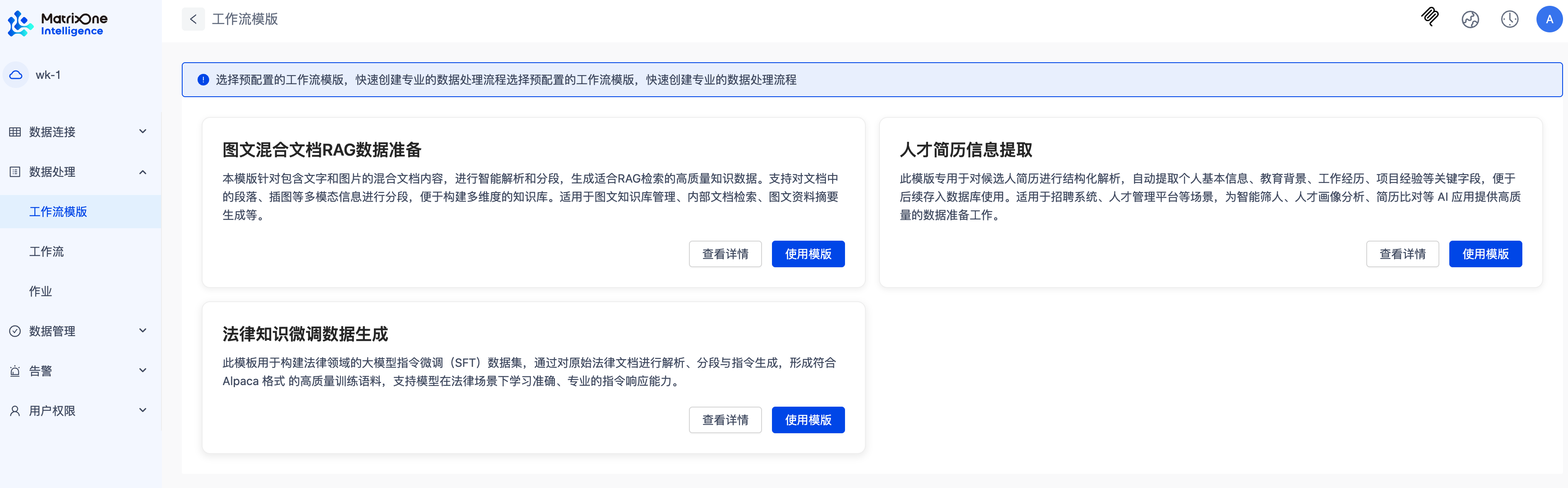
To help users quickly build efficient and stable data processing pipelines, the platform provides preset workflow templates for common business scenarios, covering core tasks such as image-text parsing, structured extraction, and knowledge generation. Users can create standardized workflows with one click based on these templates, significantly reducing setup complexity and improving data processing efficiency.
Template Advantages
-
Ready-to-Use
No need to build from scratch. Select a template to automatically generate a standardized workflow structure with clear processes and complete configurations. -
Broad Scenario Coverage
Templates cover various application needs, including mixed-format document processing, resume information extraction, legal knowledge generation, and more, meeting diverse business objectives. -
Built-in Sample Files
Each template comes with sample data. Users can directly load and test the workflow without uploading files, accelerating validation and deployment.
Using Templates
- Navigate to the GenAI Workspace.
- Click the left menu: Data Processing → Workflow Templates.
- Browse and select the desired template, then click Use Template to create a new workflow.
Sample Data Description
To facilitate quick testing and understanding of template usage, the platform provides sample files for each template at the following path:
Data Center → My Workspace → Default → Raw Data → Sample Data
No additional file uploads are required. Users can directly reference these sample files after selecting a template to immediately create a fully operational workflow.
Supported Templates
| Template Name | Application Scenario |
|---|---|
| Multimodal Document RAG Preparation | Parse books, reports, PDFs, and other mixed-format documents to generate structured knowledge data for RAG |
| Resume Information Extraction | Automatically extract fields such as personal information, education background, and work experience from candidate resumes |
| Legal SFT Data Generation | Extract key information from contracts, court judgments, and other legal documents for fine-tuning legal models |